
The Extinction of Ancient Hellas: Greece’s Low Birth Rate Crisis Leads to Muslim Majority and the Rise of the Islamic Republic of “Yunanistan” if Greek birthrates don’t reverse quickly.
In the cradle of Western civilization, a silent demographic revolution is unfolding. Greece, home to the Parthenon, Plato, and the roots of democracy, faces an existential threat not from war or invasion—but from its own plummeting birth rates among indigenous Greeks. With fertility rates hovering at a catastrophic 1.3 children per woman—one of the lowest in Europe—the indigenous Greek population is on a path to effective extinction within decades if trends continue unchecked.
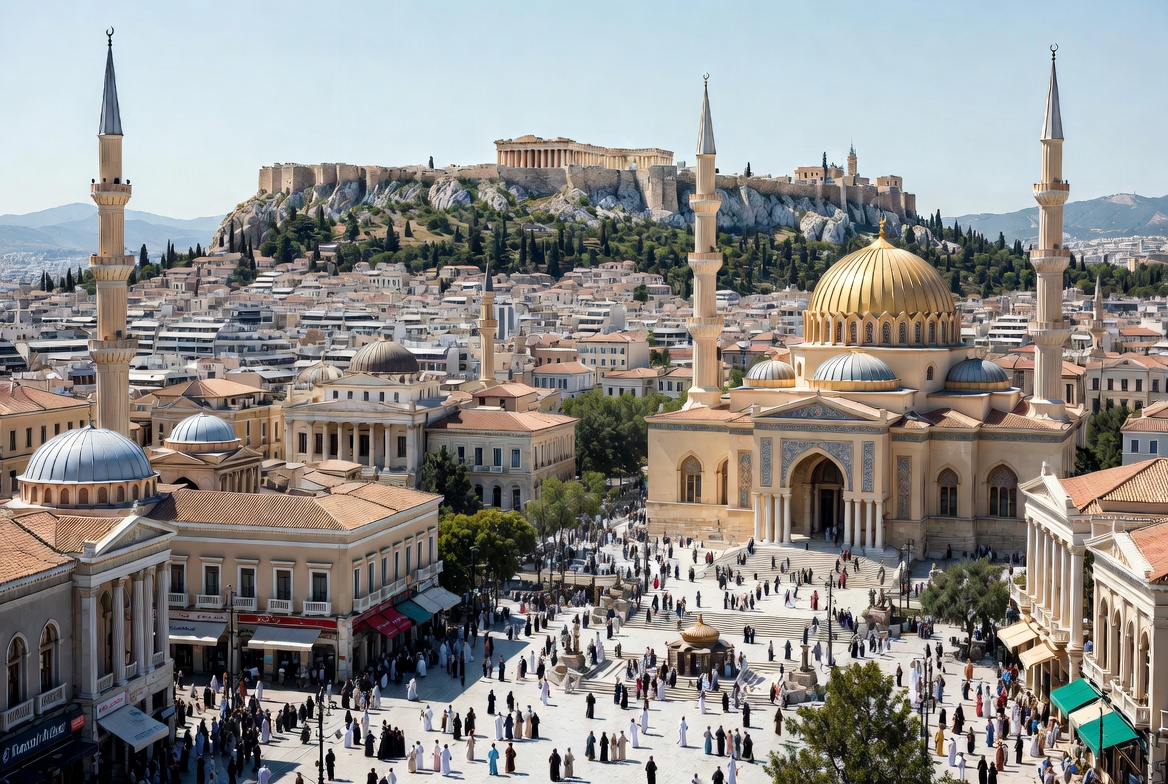
What comes next? A Muslim-majority Greece that redefines its identity, renames the nation, and embraces Islam as its state religion. This speculative but data-driven vision of Greece 2100 explores a future where the Acropolis stands beside towering minarets, and “Hellas” fades into history as the Islamic Republic of Yunanistan.
Greece’s Demographic Time Bomb: Why Indigenous Greeks Are Disappearing
Greece’s low birth rate isn’t a distant warning—it’s here now. In 2023, the country recorded just 72,300 births, half the annual average from the mid-20th century. Deaths outpace births by a wide margin, and the population has already shrunk by half a million in the last 13 years. Economists project the workforce could halve by 2100, with GDP contracting dramatically. Indigenous Greeks, who make up over 90% of the population today, are the hardest hit. High living costs, delayed marriages, brain drain, and cultural shifts toward smaller families have created a fertility crisis that no government incentives—cash bonuses, tax breaks, or subsidized childcare—have reversed.Meanwhile, immigration from Muslim-majority countries in the Middle East, North Africa, South Asia, and the Balkans has steadily increased.
Albania, Syria, Pakistan, Afghanistan, and others supply the bulk of new arrivals. Current estimates put Greece’s Muslim population at 2-6% (including the historic Thrace minority and recent immigrants), but higher fertility rates among these communities—often 2-3 children per woman—combined with ongoing migration flows are accelerating change. Without a reversal in native birth rates, projections show non-Greek, predominantly Muslim populations growing rapidly while indigenous numbers plummet.By mid-century, the math becomes undeniable. Native Greek births continue their freefall.
Migrant families, often younger and more fertile, fill the gap. Schools close on islands and in rural areas as classrooms empty of Greek children. Ghost towns emerge in the Peloponnese and Aegean. The “extinction” isn’t literal overnight—it’s a gradual demographic eclipse where indigenous Greeks become a minority in their ancestral homeland.
The Tipping Point: When Muslims Become the Majority
Fast-forward to the late 21st century. Indigenous Greeks, defined by ethnic Hellenic heritage and Orthodox Christian roots, dwindle to under 20% of the population. Muslim communities—bolstered by sustained immigration, higher birth rates, and conversions—surpass 50% and keep climbing toward 70-80%. Athens and Thessaloniki, already home to large immigrant enclaves, transform first. Rural mainland and island regions follow as economic opportunities draw families northward.
This shift mirrors broader European trends but hits Greece uniquely hard due to its proximity to migration routes and severe native fertility collapse. What was once a Christian Orthodox nation becomes a Muslim-majority state.
Political power follows demographics: Muslim-led parties gain control of parliament. Sharia-influenced policies emerge in family law, education, and public life. The Orthodox Church, long intertwined with Greek identity, loses official status and influence.
Renaming the Nation: From Greece to the Islamic Republic of Yunanistan
With the majority secured, the cultural overhaul accelerates. The name “Greece”—tied to ancient pagan and Christian Hellenic identity—gives way to something reflecting the new reality. By 2080-2100, a constitutional referendum renames the country the Islamic Republic of Yunanistan (or “Yunan” for short, from the historical Islamic term for Greece/Yunan).
“Hellas” is retired as a secular relic, much like how Constantinople became Istanbul.Islam becomes the state religion. The constitution is amended to prioritize Sharia principles alongside democratic elements. The flag evolves: the blue-and-white stripes and cross are replaced with green fields, crescents, and subtle nods to Byzantine heritage reinterpreted through an Islamic lens.
Public holidays shift—Eid al-Fitr and Eid al-Adha replace Easter and Christmas as national observances. School curricula emphasize Quranic studies, Arabic alongside Greek (now a minority language in many areas), and Islamic history over classical mythology.Ancient sites adapt.
The Parthenon hosts interfaith events or Islamic cultural festivals. Mosques multiply: the massive Athens Mosque, once controversial, becomes a model for hundreds more. Call to prayer echoes across the Acropolis. Pork bans in public institutions and halal standards in food production become the norm. Women’s dress codes in government buildings reflect modest Islamic attire.
Daily Life in Yunanistan: A Transformed Society
Imagine walking the streets of future Athens in 2125:
- Culture and Society: Traditional Greek tavernas serve halal souvlaki and baklava alongside new fusion dishes influenced by Levantine, Turkish, and South Asian flavors. Music blends rebetiko with Islamic nasheeds. Family life centers on larger, multi-generational Muslim households, reversing the low-birth-rate decline.
- Economy and Tourism: The workforce rebounds thanks to youthful Muslim demographics. Tourism evolves—”Islamic Greece” markets itself for halal vacations, with prayer rooms at beaches and alcohol-free resorts on Mykonos. Oil and gas in the Aegean, plus tech hubs in Thessaloniki, thrive under new leadership.
- Politics and Law: A moderate Islamic democracy emerges, blending European Union ties (if retained) with closer alliances to Turkey, the Gulf states, and the broader Ummah. Women’s rights and minority protections exist but align with Islamic jurisprudence.
- Heritage Preservation: Classical ruins are preserved as UNESCO sites with Islamic interpretive centers, framing ancient Greece as a precursor to the “enlightened” Islamic era. Orthodox churches become museums or shared worship spaces.
Challenges persist—lingering tensions over secular holdouts, economic inequality, and integration—but the nation stabilizes as a vibrant Muslim power in the Mediterranean.
Why This Future Matters: Lessons from Greece’s Demographic Crisis
Greece’s low birth rate among indigenous Greeks isn’t just statistics—it’s a warning for Europe. Without bold policies addressing family formation, economic security, and cultural confidence, the continent’s historic peoples risk fading. In Yunanistan, the Parthenon still stands, but its meaning evolves. The olive groves remain, now tended by new stewards. Ancient Hellas doesn’t vanish; it transforms into something the philosophers of old could scarcely imagine: a Muslim-majority beacon where Islam shapes the future of the land that birthed the West.
This scenario is speculative, grounded in today’s fertility data, migration patterns, and demographic math. But the trends are real. Will Greece act to save its indigenous population, or embrace the inevitable shift? The clock is ticking. For more on Europe’s changing demographics, search “Greece low birth rate 2025,” “Muslim population projections Europe,” or “future of Hellenic identity.” What do you think the next chapter holds?
For more interesting articles, visit GlobalGreeks.com