

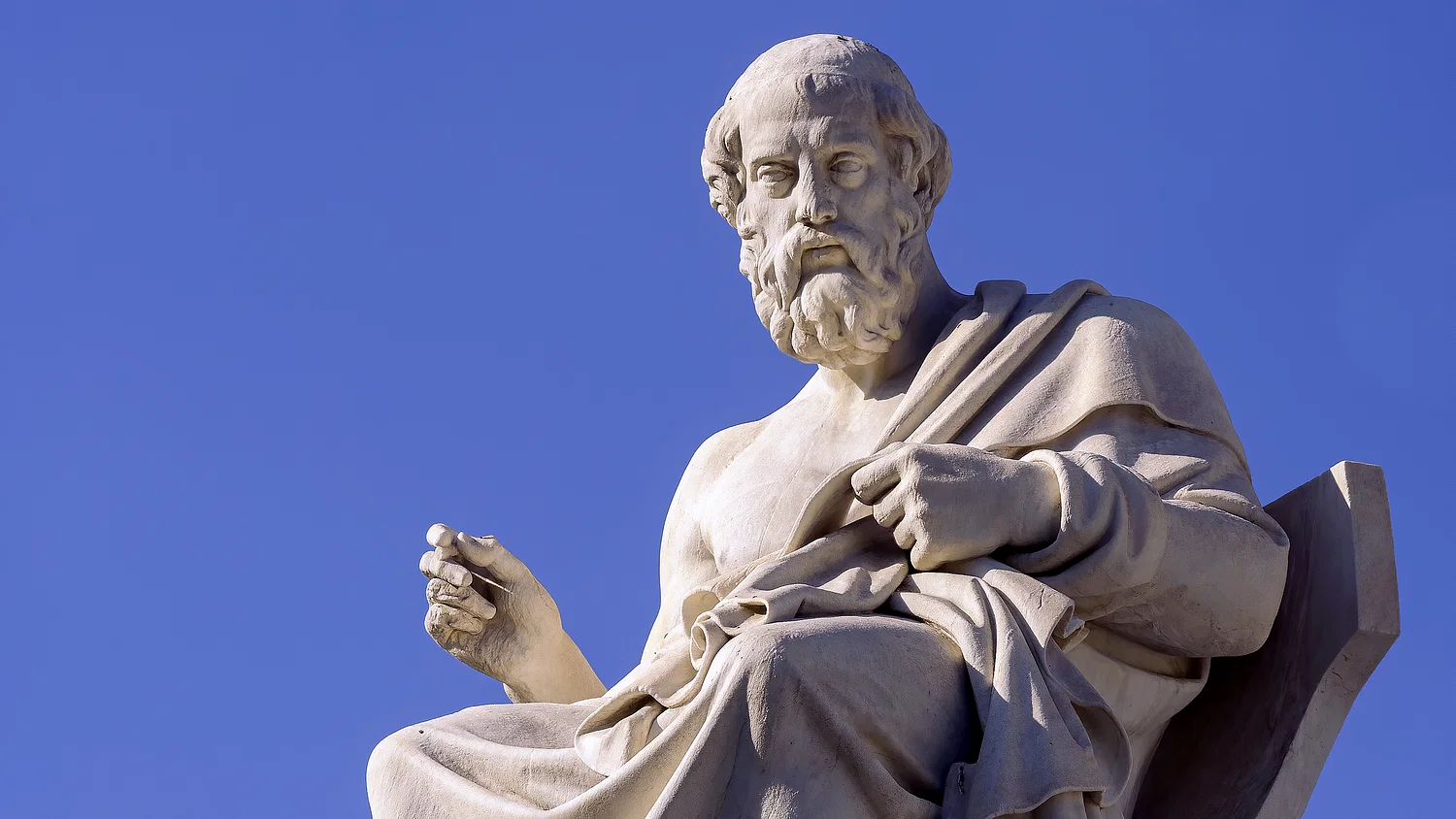
Plato (c. 428–347 BCE) stands as one of history’s most influential thinkers — student of Socrates, teacher of Aristotle, and founder of the Academy, often called the world’s first university.
But beyond his famous Theory of Forms and dialogues like The Republic, Plato’s life and legacy hold some surprising, lesser-known details.Here are five fascinating random facts that reveal a more human (and sometimes quirky) side to the legendary philosopher.
1. “Plato” Was Actually a Nickname
His real name was likely Aristocles, after his grandfather. The moniker “Plato” (from the Greek platon, meaning “broad” or “wide”) probably came from his wrestling coach, referring to his broad shoulders, sturdy build, or even the breadth of his forehead or writing style.
The nickname stuck so well that history remembers him only as Plato — proof that even ancient philosophers had playground nicknames that endured for millennia.
2. He Was a Wrestler and a Soldier
Before devoting himself fully to philosophy, young Plato competed as a wrestler and may have participated in the Isthmian Games (similar to the Olympics). He also served in the Athenian military during the later years of the Peloponnesian War (around 409–404 BCE), fighting for his city-state against Sparta. This athletic and military background adds a rugged, physical dimension to the man famous for abstract ideas about justice and the soul.
3. He Founded the First Western “University” — And It Lasted Nearly 900 Years
Around 387 BCE, Plato established the Academy in a grove outside Athens sacred to the hero Academus. This wasn’t just a casual discussion group; it functioned as an institution of higher learning, teaching philosophy, mathematics, astronomy, and science. It operated for almost 900 years until it was closed by Emperor Justinian in 529 CE — making it one of the longest-running schools in history and the direct ancestor of the modern word “academy.”
4. On His Deathbed, He Reportedly Listened to Flute Music
Plato was famously critical of certain arts and music in The Republic, suggesting that flutes should be banned in his ideal society in favor of the more “dignified” lyre. Yet legend says that as he lay dying at around age 80–81, he asked a young girl to play the flute for him, tapping out the rhythm with his finger until his last breath. It’s a touching, ironic contrast between his philosophical ideals and his very human final moments.
5. His Complete Works Survived Intact for Over 2,400 Years
Unlike most ancient authors whose writings were lost or survive only in fragments, nearly all of Plato’s dialogues and letters have come down to us remarkably complete. This rare preservation has allowed his ideas — from the immortal soul and reincarnation to critiques of democracy and visions of an ideal state — to influence thinkers from Aristotle to Alfred North Whitehead, who famously called the entire European philosophical tradition “a series of footnotes to Plato.”
These facts show Plato wasn’t just an ivory-tower thinker — he was a wrestler, soldier, educator, and complex human being whose influence stretches from ancient Athens to modern classrooms.
Whether you’re diving into The Republic or just pondering the nature of reality, Plato’s legacy continues to spark curiosity and debate after more than two millennia.Which of these surprised you most? Got a favorite Plato dialogue or idea you’d like explored next?
Check out other cool articles on our website GlobalGreeks.com