

The British Occupation of Constantinople in 1919: Allied Control, Greek Hopes, and the Broader Tragedy of Displacement.
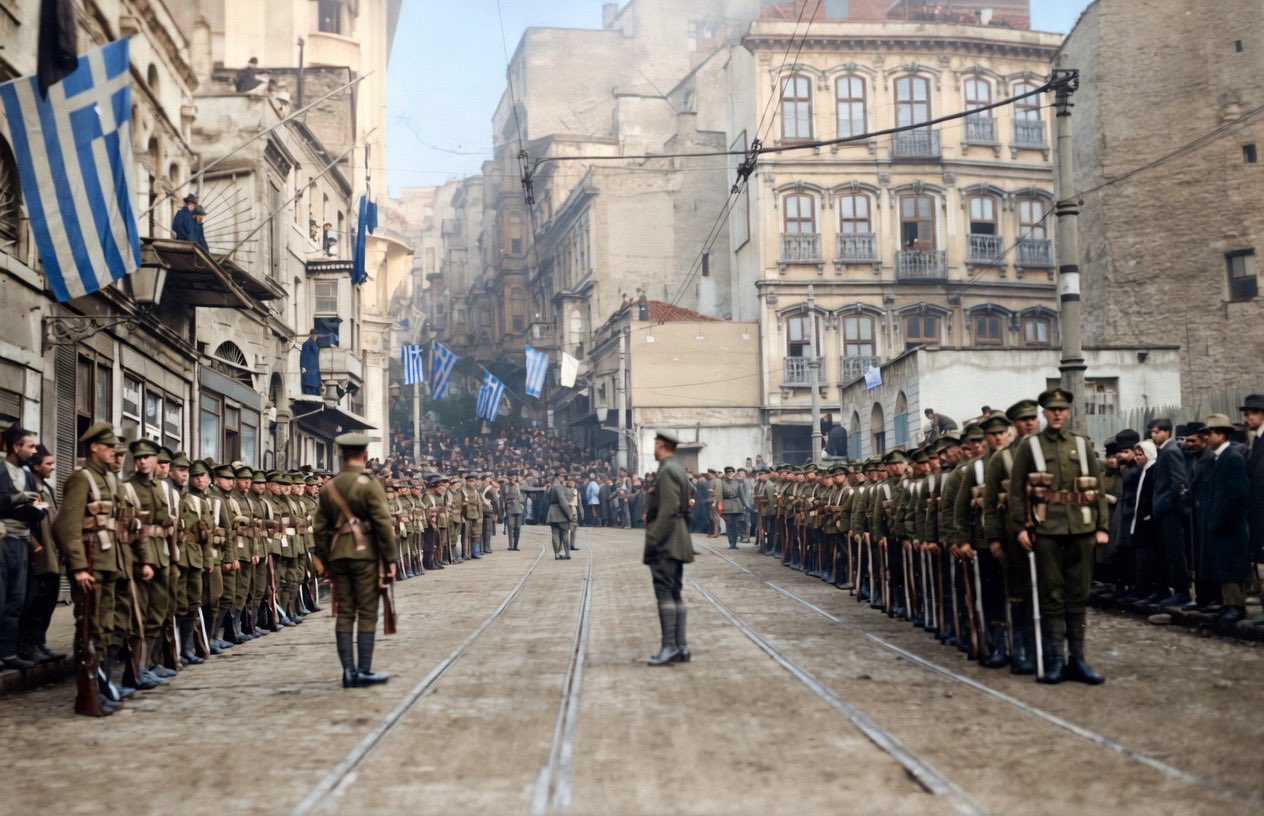
In the aftermath of World War I, the once-mighty Ottoman Empire lay defeated. The Armistice of Mudros, signed on October 30, 1918, ended Ottoman participation in the war and opened the door for Allied occupation of key territories, including the imperial capital, Constantinople (modern-day Istanbul). What began as a limited Allied presence in November 1918 evolved into a full multinational occupation that lasted until 1923. British troops played the dominant role, entering the city on November 13, 1918—one day after French forces—and quickly establishing control over strategic districts.
By early 1919, the occupation had solidified, with British forces overseeing much of the city’s administration amid a fragile peace. The British Army of Occupation, under commanders like General George Milne and later General Charles Harington, patrolled the streets alongside French, Italian, and (later) small contingents of Greek troops. Zones were divided for policing and administration: the historic Stamboul (old city) fell under French control, Pera-Galata (the European quarter) under British oversight, and the Asian-side districts like Kadıköy and Üsküdar under Italian authority.
British soldiers—many from India and other imperial territories—marched through Pera and Taksim, requisitioned buildings, and enforced Allied military law. Their presence symbolized the humiliating defeat for Ottoman Turks but brought a measure of order and protection for the city’s diverse minorities. Constantinople in 1919 was a city of roughly 800,000 to 1.2 million people, with Muslims forming less than half the population and substantial Greek Orthodox, Armenian, and Jewish communities making up the rest. The Greek (Rum) population numbered well over 200,000, concentrated in districts like Phanar (Fener), where the Ecumenical Patriarchate resided.
For many local Greeks, the Allied—particularly British—presence raised hopes tied to the Megali Idea (“Great Idea”), the dream of reclaiming Constantinople and expanding Greek influence across former Ottoman lands with significant Greek populations. Greek troops symbolically entered the city in November 1919, welcomed by cheering crowds in Phanar. The vibrant Greek community thrived culturally and economically under occupation, with businesses, churches, and schools operating openly. Allied forces, including the British, generally shielded Christian minorities from immediate Turkish nationalist reprisals in the capital itself.
Yet the occupation did not bring unalloyed security for Greeks—nor was it the site of direct British-Turkish collaboration against them. Contrary to some narratives, there was no mass displacement or expulsion of Constantinople’s Greeks by British troops and Ottoman/Turkish authorities in 1919. Deportations and persecutions of Ottoman Greeks had peaked during World War I (1914–1918), when hundreds of thousands were forcibly moved inland or killed as suspected security threats. In the occupied capital, however, the British-led administration largely halted such actions, focusing instead on disarming Turkish nationalists and maintaining order. British forces even arrested Turkish deputies and nationalists in March 1920 to suppress resistance.
The real harm to Greek communities came from the wider regional fallout of Allied policies, including Britain’s own. In May 1919—mere months into the solidified occupation—British Prime Minister David Lloyd George strongly backed the Greek landing at Smyrna (Izmir), authorizing Greek troops to occupy the city and its hinterland under the guise of protecting local Christians. This move, intended in part to counter Italian ambitions and weaken Turkish resistance, ignited the Greco-Turkish War (1919–1922). Greek forces advanced deep into Anatolia, but Turkish nationalists under Mustafa Kemal Atatürk rallied in response. As fighting intensified, both sides committed atrocities that devastated civilian populations. Turkish nationalist forces targeted Greek Orthodox communities in the interior, rounding up men for labor battalions, deporting families, and carrying out massacres—part of a pattern of ethnic violence that had begun earlier but accelerated with the war. Greek armies, in turn, were accused of burning villages and reprisals against Muslim civilians during their advance and scorched-earth retreat. British support proved fickle: initial enthusiasm waned as the campaign dragged on, and by 1922, Britain withdrew backing, contributing to the Greek collapse.
The Turkish recapture of Smyrna in September 1922 triggered the “Great Catastrophe”—the flight of hundreds of thousands of Greeks amid chaos, fire, and violence. An estimated 150,000–200,000 Greeks and Armenians fled or were expelled from Smyrna alone. The war’s end formalized the suffering through the 1923 Treaty of Lausanne and the compulsory Greece-Turkey population exchange. Over 1.2 million Greek Orthodox Christians were uprooted from Anatolia and Eastern Thrace, exchanged for roughly 500,000 Muslims from Greece.
Constantinople’s established Greek community (the “Rum”) was largely exempted, allowing tens of thousands to remain—though their numbers would dwindle dramatically in later decades due to other pressures. In this sense, British strategic decisions in 1919 helped spark a conflict that, alongside Turkish military actions, displaced and devastated Greek populations across Anatolia.
The occupation of Constantinople itself, however, served more as a temporary haven for the city’s Greeks than a mechanism of their expulsion. By October 1923, the last Allied troops—including the British—had withdrawn as the Republic of Turkey asserted full sovereignty. The occupation had preserved the city from immediate partition but failed to deliver lasting stability or justice for its minorities. For the Greek people of the former Ottoman lands, 1919 marked not displacement in Constantinople but the beginning of a chain of events that shattered centuries-old communities.
The British role, while protective in the capital, was indelibly linked to the broader tragedy through their sponsorship of Greek expansionism—a policy that ultimately left Greeks exposed to Turkish victory and forced exile. Today, the events underscore the human cost of great-power maneuvering in the collapse of empires.
Check out more stories on GlobalGreeks.com