
In the rugged mountains of Arcadia, Peloponnese, where fir forests whisper and stone houses stand like silent witnesses, lies one of Greece’s most surprising hidden gems: the village of Lasta.
Once home to around 300 residents, Lasta today feels like a living museum of what many rural Greek villages are quietly becoming.
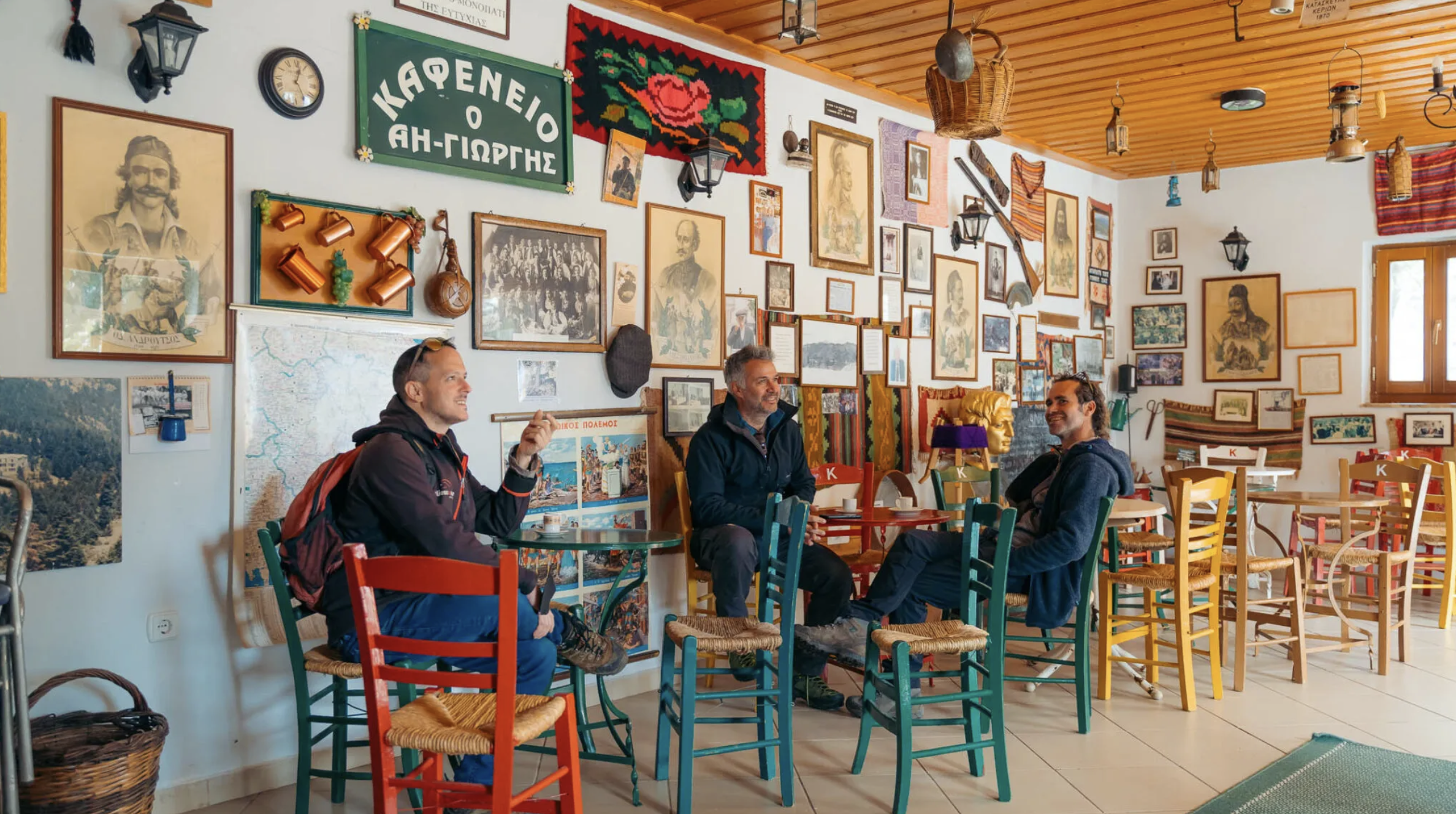
Permanent population? Barely a handful—recent reports put it at just three souls. Crumbling stone homes line empty paths. The old school sits quietly, slowly transforming into a guesthouse. Yet right in the heart of this near-ghost town, next to the sturdy stone church of Agios Georgios (built in 1876), beats a small but mighty heart of Greek hospitality: the Kafeneio Ai Giorgis—a self-service café with no staff, no owner on duty, and no cash register.
Just trust.You park a bit below the village square, walk up the path (maybe with a friendly local dog as your escort), and step into the large paved platia with its panoramic views. The café sits unassumingly beside the church. Push open the door and you’re greeted not by a barista, but by an old radio-cassette player, stacks of backgammon boards and playing cards, colorful wooden chairs, woven tapestries, and walls covered in sepia photos of Lasta’s past—portraits of villagers, heroes from the 1821 Revolution, and scenes that feel pulled straight from a family album.There’s no menu, no service.
A simple sign welcomes you as a guest: make your own coffee using the supplies and utensils provided, help yourself to water, a splash of ouzo if you like, or a sweet loukoumi (Turkish delight). When you’re done, wash your cup, tidy up, and drop whatever you can into the little “cashier” piggy bank for the maintenance of this historic spot.As local guide Lambros Papalambros from nearby Vytina puts it: “Anyone can come here and make their own coffee… Their only obligation is to leave it as they found it, clean and tidy.”It sounds almost too idealistic in 2026, yet it works. Visitors—hikers heading toward the ascetarium of Sfyrida or the northern slopes of Mount Menalon, curious travelers, and the occasional diaspora Greek tracing roots—respect the space.
The café stays remarkably clean and inviting, more like a folk art museum than a business. It runs entirely on that classic Greek filotimo—the sense of honor and shared responsibility that once kept village doors unlocked and neighbors looking out for one another.On August 15 each year, the square comes briefly alive again for the village fair, drawing scattered families back for music, food, and connection. But most days, Lasta is quiet. The perpetual plane tree shades the old school.
The church bells might ring for no one in particular. And the kafeneio waits patiently for the next person willing to brew their own Greek coffee and leave a little something behind.For Global Greeks, this tiny spot hits different. It’s a poignant reminder of the villages our grandparents or great-grandparents left behind during waves of emigration, economic hardship, or simply the pull of city life and better opportunities abroad. While we sip our overpriced lattes in bustling diaspora communities, Lasta’s self-service café quietly asks: What happens when the young leave and the old pass on?
Can trust and a piggy bank keep a piece of our heritage breathing?Yet there’s hope and charm here too. Hikers refill their energy before heading into the forests. Travelers stumble upon it as a pleasant surprise and leave with stories.
And every donation dropped in that box helps preserve something authentic in an increasingly modern world.If you ever find yourself driving through Arcadia, near Vytina, take the detour to Lasta. Park, walk up to the square, step inside Ai Giorgis, and make yourself a coffee the old-fashioned way. Leave the place spotless. Drop a few euros (or more) in the box.
Sit for a moment under the weight of all those old photographs.In a country famous for its warm hospitality, Lasta offers something even rarer: the chance to become part of the hospitality itself.And who knows? Maybe while you’re stirring your coffee, one of the village’s three remaining residents will wander by, or that friendly dog will keep you company.
Either way, you’ll leave feeling like you touched something real—something wacky, trusting, and deeply Greek.