

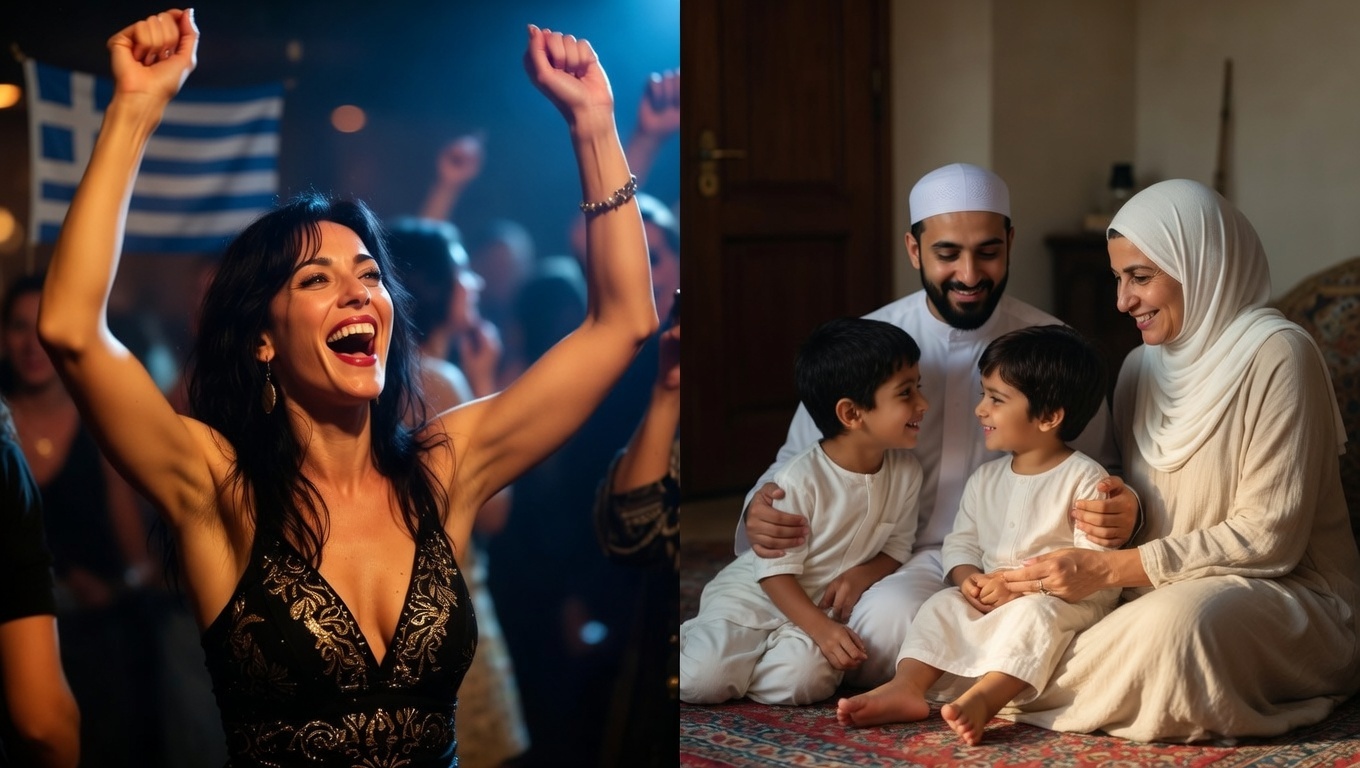
Look around.
You see it everywhere now. Every Greek bar. Every Greek church. It’s everywhere.
Greek childless singles in their 30’s and 40’s.
What’s going on?…
Greece faces a profound demographic crisis. Its total fertility rate stands at around 1.26–1.32 children per woman, with recent projections for the mid-2020s at approximately 1.27—far below the 2.1 replacement level needed for population stability. Birth rates are low at about 6.8 per 1,000 people, marriage rates have fallen to 3.87 per 1,000, and the population continues to shrink.
Many Greeks now delay marriage significantly, with the average age at first marriage reaching 32.9 for men and 30.1 for women. Permanent celibacy rates for men have climbed to around 22.4% by age 50 in newer cohorts.
As a result, a large portion of modern Greeks remain single well into adulthood, end up childless, or have only one child, often influenced by cultural marxism, or prioritizing career advancement, maybe it’s economic security and personal fulfillment over early family life.
In stark contrast, Muslim communities across Europe sustain higher fertility and more traditional family structures.
Muslim women in Europe average roughly 2.6 children, compared to about 1.6 among non-Muslims—a persistent gap of roughly one additional child per woman. In some countries, the difference is even wider (e.g., 3.1 vs. 1.7). This higher fertility stems from earlier marriage—often in the early to mid-20s—strong cultural norms emphasizing family and parenthood, and a societal valuation of larger families as a source of strength and continuity.
This divergence becomes even more telling when viewed through the lens of cultural influences. Many Europeans, including Greeks, have been profoundly shaped by ideas often described as cultural Marxism or related progressive ideologies that emerged from mid-20th-century communist movements.
These emphasize individualism, secularism, self-realization, gender egalitarianism in career terms, and skepticism toward traditional institutions like early marriage and large families. Such shifts have contributed to delayed childbearing, higher rates of childlessness, and a cultural pivot away from family as a central life priority toward personal autonomy and material pursuits.
In Greece, this has manifested in a move toward more secular, individualistic orientations, where young women (and men) focus on education and professional careers before considering parenthood, leading to later and fewer children.Muslim communities in Europe, however, have largely resisted these influences. They have maintained traditional family values rooted in religious and cultural teachings that prioritize early marriage, procreation, and extended family support.
Islam’s emphasis on family as a core social unit has proven resilient against the individualism and post-materialist values that have reshaped much of Western Europe. This cultural steadfastness has enabled Muslims to form families younger and have more children, even amid economic challenges or minority status in host societies.The historical backdrop between Greeks and Muslims adds layers of complexity to this comparison.
Greeks endured nearly four centuries of Ottoman (Muslim) rule following the 1453 fall of Constantinople, followed by the bloody 1821 War of Independence, the 1919–1922 Greco-Turkish War, the traumatic 1923 population exchange displacing over a million people, and ongoing tensions, including over Cyprus. These events fostered deep mutual distrust and cultural scars that persist in collective memory.Yet, demographic realities demand looking beyond past grievances.
Muslims are succeeding remarkably at what many modern Greeks have struggled with: building robust families early in life and sustaining population growth through multiple children. Where many Greeks now opt for singlehood or one-child families in their 30s, Muslim norms encourage marriage and parenthood in the 20s, viewing children as blessings and community anchors.
The lesson for Greece is urgent. A society that does not reproduce itself risks losing its language, Orthodox Christian heritage, traditions, and national identity over generations. While economic incentives like child bonuses, tax relief, and family support programs (with Greece planning significant investments through 2035) are essential, they alone have proven insufficient without addressing deeper cultural shifts.
Greece could benefit by examining how Muslim communities have preserved traditional values against prevailing Western ideological currents—encouraging earlier family formation, celebrating larger families, and re-centering parenthood as a fulfilling, normative life goal rather than a delayed option.This is not about adopting another religion or erasing Greek identity.
It is about recognizing that cultural resilience in family matters can counteract demographic decline. Historical enmities should not prevent learning from effective practices that protect a people’s future.
If Greeks continue down the path of individualism influenced by post-traditional ideologies, the consequences—aging populations, strained welfare systems, and cultural erosion—will be irreversible. The Muslim example of steadfast family values offers a practical model for renewal. The window to act, and to draw constructive insights where they exist, is narrowing fast.
Greeks are losing – losing bad.