
If you want to stand at the very edge of Greece, where Europe meets Asia across a narrow stretch of sparkling sea, head to Kastellorizo, also known as Megisti. This remote Dodecanese island is Greece’s easternmost inhabited territory, lying just 2 kilometers (about 1.2 miles) off the Turkish coast near Kaş, yet roughly 125 km east of Rhodes and a staggering 570 km southeast of Athens.
Officially called Megisti (“the greatest”) since antiquity because it is the largest in its small archipelago, the island feels like a living frontier — colorful, resilient, and proudly Greek despite its isolation. Kastellorizo’s dramatic location makes it one of the most strategically significant specks in the Mediterranean.
The island’s tiny size (just 9–11 square kilometers) belies its importance: together with nearby uninhabited islets like Ro and Strongyli (the absolute easternmost point of Greek territory), it anchors Greece’s maritime claims in the Eastern Mediterranean. From its harbor, you can almost hear roosters crowing on the Turkish mainland — a daily reminder of how close yet distinct this outpost remains.The island’s history reads like a Mediterranean epic.
Inhabited since Neolithic times and colonized by Dorian Greeks, Kastellorizo thrived as a maritime hub in the 19th century with a population once exceeding 10,000 thanks to shipping and sponge fishing. Over the centuries it passed through Byzantine, Knight of St. John, Ottoman, and Italian hands before formally joining Greece in 1947.
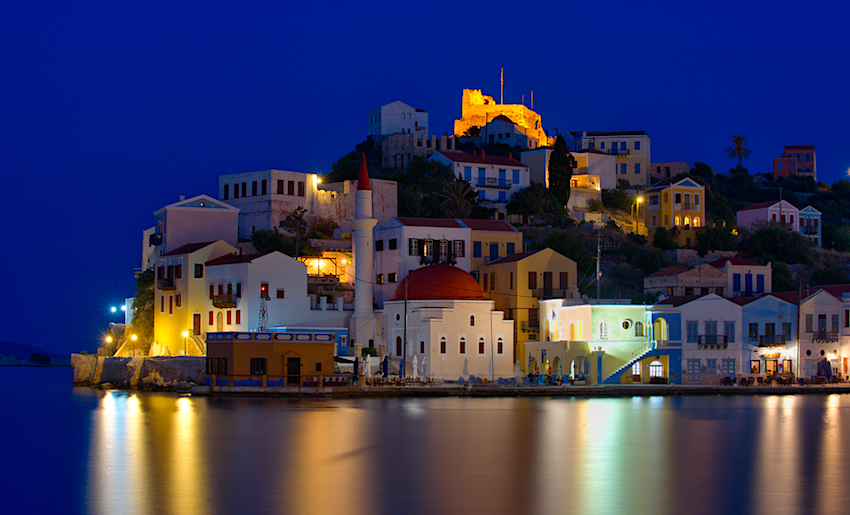
The medieval Red Castle (Castello Rosso) that gave the island its modern name still overlooks the harbor, while neoclassical pastel-colored houses line the waterfront in a postcard-perfect amphitheater. The Oscar-winning 1991 film Mediterraneo put Kastellorizo on the map for many, capturing its charm during WWII.Today, with a year-round population of around 492–500, Kastellorizo offers an authentic escape from mass tourism.
There are no sandy beaches or big resorts — just crystal-clear turquoise waters, dramatic rocky coastline, and a peaceful vibe that feels worlds away from busier Greek islands. The star attraction is the famous Blue Grotto (or Blue Cave), a sea cave where you enter on your back through a low opening and emerge into an ethereal electric-blue chamber lit by sunlight refracting through the water. Boat tours from the harbor take you there early in the morning for the best light and a chance to swim inside.
Other highlights include hiking up to the Monastery of Saint George of the Mountain for panoramic views and intricate mosaics, exploring the Knights’ Castle ruins, or taking day trips to tiny nearby islets. Swimming and snorkeling in the sheltered bays are world-class, and the harbor tavernas serve fresh seafood with that unmistakable Greek hospitality. Many locals have diaspora ties — some even Australian-Greek — adding layers of warmth and stories from around the world.
Getting to Kastellorizo is part of the adventure. There are no airports, so access is by sea: ferries from Rhodes (2.5–5 hours depending on the vessel), occasional connections from Piraeus, or quick daily boats from Kaş in Turkey during the season (just 20–30 minutes). The remoteness keeps crowds low and the experience genuine — perfect for travelers seeking quiet beauty rather than nightlife.
In an era when Greece faces demographic pressures and questions of identity, Kastellorizo stands as a powerful symbol: a small but steadfast guardian of Greek presence at the farthest eastern edge. It reminds us that even the tiniest outposts carry the soul of the nation.
Whether you visit for the Blue Grotto’s magic, the history, or simply to feel what it means to be on the frontier, this island leaves a lasting impression.Have you dreamed of visiting Greece’s easternmost island? Or do you have family stories from the Dodecanese? Drop them in the comments — and stay tuned for Part 2 on more hidden gems of remote Greek islands.
Check out GlobalGreeks.com for more cool articles