

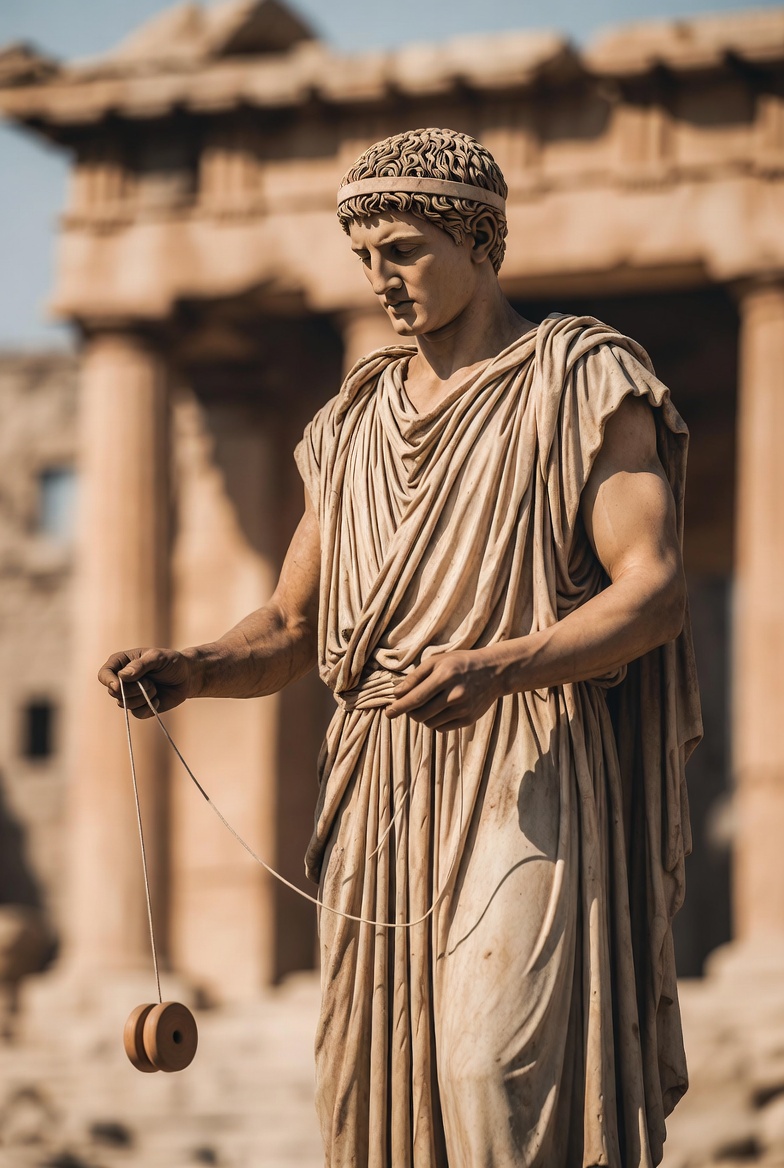
Long before plastic tricks, global competitions, and even the name “yo-yo” itself, a simple spinning toy captivated children in ancient Greece. Dating back to at least the 5th century BCE (around 500–440 BC), evidence from vase paintings and surviving artifacts shows young boys flicking disk-like objects on strings—early versions of what we now recognize as the yo-yo.
These weren’t mass-produced gadgets but handmade items crafted from wood, terracotta (fired clay), bronze, or metal, often decorated with mythological scenes like gods, animals, or heroes.One of the most famous depictions appears on an Attic kylix (a drinking cup) from around 440 BC, now in museum collections: a Greek youth stands casually, string in hand, as the disk spins at the end.
Such images, preserved in places like the National Archaeological Museum in Athens, offer a charming glimpse into everyday play amid the grandeur of classical Greece. Historians often call the yo-yo the second-oldest known toy after dolls, highlighting how universal childhood joy has always been.The ancient Greek versions were simple yet ingenious.
Two disks connected by an axle held a looped string (unlike modern tied strings), allowing the toy to drop, spin, and return with a flick of the wrist—much like today’s basic yo-yo mechanics. Some terra-cotta examples were fragile, leading scholars to suggest they doubled as ritual objects: when a child reached maturity or “came of age,” they might dedicate their childhood toys to gods like Artemis or Apollo as votive offerings in temples.
This blend of play and ceremony adds a deeper cultural layer—fun wasn’t just frivolous; it marked life’s transitions.While Greece provides the earliest clear pictorial and artifact evidence of something yo-yo-like, the toy’s true origins likely trace further back to China around 1000 BCE, where a related spinning toy called the diabolo emerged. From there, it probably spread along trade routes to the Mediterranean, reaching Greece and even the Philippines, where yo-yo traditions thrived independently.
The word “yo-yo” itself comes from Tagalog (“come-come”), popularized in the 1920s by Filipino-American inventor Pedro Flores, but the concept was already ancient by then.
Some debate lingers: certain ceramic “disks” found in graves (like bobbins or decorative pieces) were once misidentified as yo-yos, but vase art and functional designs strongly support the toy interpretation for many examples. Whether purely recreational or symbolic, these objects reveal that ancient Greek kids shared the same delight in watching something fall and snap back up that modern enthusiasts feel during a sleeper or walk-the-dog trick.
The yo-yo’s journey from ancient agora to modern stage is a testament to timeless design. Simple, portable, and endlessly entertaining, it survived empires, evolved through French nobility (who called it “bandalore” or “jou-jou”), exploded in popularity in 20th-century America thanks to marketing genius Donald F. Duncan, and even floated into space on NASA shuttles for microgravity experiments.Today, when you loop a string and send a yo-yo spinning, you’re connecting to a tradition that stretches back over 2,500 years—to the sun-drenched streets of Athens, where a boy in a chiton might have shown off the same move to his friends. In a world of high-tech gadgets, the humble yo-yo reminds us that some inventions are so perfectly simple they never go out of style.
So next time you pick one up, give a nod to those ancient Greeks. They didn’t just build democracies and temples—they gave the world a toy that keeps coming back, just like history itself.