


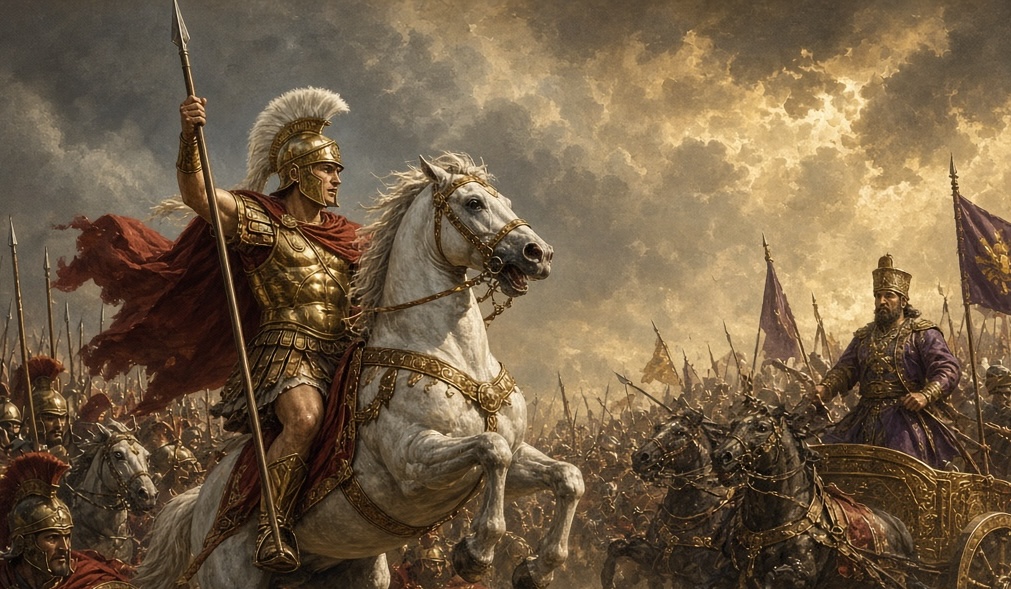
On This Day: Alexander the Great Defeated Darius III at Gaugamela
On 1 October 331 BC, on a plain east of the Tigris in what is now northern Iraq, Alexander the Great broke the field army of Darius III and effectively decided the fate of the Achaemenid Empire.
The Battle of Gaugamela — also called the Battle of Arbela after the nearby city — was the second and final clash between the two kings. Issus in 333 BC had wounded Persian prestige. Gaugamela finished the argument.
For readers of Greek history, the date is more than a military anniversary.
It is the moment a Macedonian expedition, launched from the northern edge of the Greek world, became a claim to rule Asia.
Why Gaugamela matteredDarius chose the ground.
After Issus, where the narrow coastal plain had cramped his numbers, he wanted space. He moved north from Babylon through Arbela and prepared a wide plain so his cavalry and scythed chariots could maneuver. Ancient writers say the Persians even leveled obstacles to give those chariots a clear run.
Alexander arrived from the west after securing the eastern Mediterranean and Egypt. He had crossed the Euphrates and then the Tigris, refusing to let Darius dictate the war by distance alone. A victory here meant the royal road to Babylon, Susa, and Persepolis lay open.
A defeat would have left his army deep inside hostile country with no easy retreat.The name Gaugamela is usually explained as “the Camel’s House,” a village on the river Bumodus. Ancient sources often call the fight Arbela because that was the better-known city nearby.
Modern scholarship places the battlefield in the region east of Mosul, near Erbil in Iraqi Kurdistan, though the exact spot is still debated. The date, long argued over, is now widely accepted as 1 October 331 BC, supported by Babylonian astronomical records.
Two armies, one open plainNumbers in the ancient accounts are not reliable.
Greek and Roman writers give Darius anywhere from hundreds of thousands to a million men.
Modern estimates are lower and still vary widely, often between roughly 50,000 and 250,000.
What is clear is that the Persian host was larger, especially in cavalry drawn from the central and eastern satrapies, including Iranian horse and allied Saka cataphracts.Alexander’s army was the smaller, tighter instrument: on the order of 40,000 infantry and about 7,000 cavalry, built around the Macedonian phalanx, the Companion cavalry, and allied Greek and Thessalian horse.
Darius also fielded Greek mercenaries, longer spears meant to match the Macedonian sarissa, scythed chariots, and a small number of elephants that played little or no part in the fighting.
The Persian advantage was mass and width. The Macedonian advantage was cohesion, training, and a commander who intended to create a gap rather than trade blow for blow across the whole line.
How Alexander broke the Persian lineAlexander did not charge straight at the center.
He advanced obliquely toward the Persian left, stretching Darius’s line and pulling units out of position. As the Persian cavalry tried to overlap the Macedonian right, a gap opened near the royal center.
That was the moment. Alexander led the Companion cavalry into the opening, aiming at Darius himself.
Ancient narratives describe the Great King fleeing once the charge reached his position — not a romantic detail invented later, but the decisive political fact of the day.
With the king gone, the Persian center lost its reason to stand.
On the Macedonian left, Parmenion’s wing came under heavy pressure and sent for help. Alexander broke off the pursuit to answer that call. By the time the crisis there eased, the Persian army was already unraveling. Darius escaped with a small escort toward the Iranian highlands and Ecbatana. Mazaeus, who had commanded the Persian right, fell back on Babylon and later surrendered the city.
Casualty figures are as inflated as the army sizes. Arrian’s claim of about 100 Macedonian dead is almost certainly too low; other ancient writers give higher numbers. Persian losses were heavy by any account. The strategic result did not depend on the exact tally: Darius no longer had a field army capable of holding the western capitals.
After the dust settledBabylon opened its gates within weeks. Alexander entered as a victor who could afford, at least at first, to keep local officials in place — Mazaeus was appointed satrap. Susa followed.
By early 330 BC, Persepolis was in Macedonian hands.
Darius was later killed by his own officer Bessus, who briefly claimed the throne before Alexander hunted him down.Gaugamela did not end the war. Resistance continued in the east, and Alexander’s later campaigns in Bactria, Sogdiana, and India belong to a different chapter. It did end the Achaemenid dynasty as a functioning imperial power.
The empire founded by Cyrus the Great passed, in practice, to a king from Macedon who now styled himself lord of Asia.A Greek story with an Asian stageFor a site devoted to the Greek world, Gaugamela is a boundary moment.
The army that won it was Macedonian in command and core, reinforced by Greek allies and mercenaries, using tactics refined under Philip II. The prize was not another city-state or a stretch of the Aegean coast.
It was the Persian royal infrastructure: roads, treasuries, satrapies, and the idea that one king could rule from the Mediterranean to the Iranian plateau.
That is why the battle still draws writers and readers more than two millennia later. It is not only a cavalry charge. It is the point at which Greek military culture, carried east by Alexander, collided with the largest empire of its age and came away holding the capitals.
Key facts at a glance
- Date: 1 October 331 BC
- Also known as: Battle of Arbela
- Location: Plain of Gaugamela, near Arbela (modern Erbil area), northern Iraq
- Commanders: Alexander the Great; Darius III
- Result: Macedonian victory; Darius flees
- Immediate consequence: Babylon, Susa, and Persepolis fall in the months that follow
- Historical significance: Decisive blow to the Achaemenid Empire